Dating Strategy
Why 90% of Guys Are Invisible on Dating Apps (And How to Not Be One of Them)
Nobody tells you this before you download the apps: online dating isn't a level playing field. It's not even close. You're not competing against "everyone in Vegas between 25 and 40." You're competing against every man in that age range who's also swiping, at the same time, in the same six-mile radius, and the app is quietly ranking all of you against each other. Some guys get buried in messages. Most guys get a few matches a month and wonder what's wrong with them. That gap isn't random, and it isn't really about looks the way people assume. It's about math — and once you understand the math, you can actually do something about it.
This is the conversation nobody wants to have, because it's uncomfortable. It's easier to believe dating apps are a slot machine — swipe enough times and eventually you win. But if you've been putting in real effort for months with barely anything to show for it, you already know it's not a slot machine. It's a popularity contest with an algorithm keeping score, and most men are playing it with a stacked deck they don't even know is stacked.
The Uncomfortable Truth About How Dating Apps Actually Work
Multiple studies and internal app data over the years have pointed to the same pattern, over and over, across different apps and different cities: a relatively small percentage of men account for a hugely disproportionate share of the likes, matches, and messages that women send. It's not a 60/40 split. It's not even close to even. The attention on apps like Tinder, Bumble, and Hinge concentrates hard at the top and thins out dramatically as you move down the pack.
Compare that to how women typically experience the same apps, where matches and messages tend to be far more evenly distributed. That asymmetry is the single most important fact about modern dating apps, and almost nobody explains it to men before they build a profile.
Here's why it happens. Dating apps are, functionally, attention marketplaces. Women (and this holds across most straight dating apps) are typically fielding a much higher volume of incoming interest than men are. When you're getting flooded with options, you don't carefully evaluate every profile — you can't, there isn't time. You make fast, instinctive judgments in a second or two, mostly based on the first photo, and you swipe. That's not shallow, that's just how the human brain handles an overwhelming amount of choice. It defaults to quick pattern recognition.
So the profiles that get the benefit of the doubt are the ones that pass that instant, subconscious filter — sharp, confident, well-lit, clearly composed, unmistakably attractive at a glance. Everything else, even profiles that are perfectly nice, gets scrolled past in under a second and never gets a second look. Not because the guy isn't a good option. Because the photo didn't do the one job it had to do.
It's a Distribution Problem, Not Just a "Looks" Problem
This is the part people get wrong. They hear "the top guys get most of the matches" and assume it means only conventionally good-looking men have a shot. That's not what's happening. What's actually happening is a distribution problem — attention flows toward whoever clears a certain bar of presentation, and average presentation doesn't clear that bar, regardless of what the person actually looks like in person.
Plenty of genuinely attractive, interesting, successful men are sitting at the bottom of that distribution because their photos are working against them — bad lighting, awkward angles, blurry group shots where a stranger has to guess which guy is even the profile owner, gym mirror selfies, photos that are three years and fifteen pounds out of date. Meanwhile guys who are, by any objective measure, more average-looking are cleaning up because their photos are sharp, well-composed, and strategically built to signal exactly what someone scrolling past in half a second needs to see.
That's genuinely good news if you think about it correctly. It means the lever you have the most control over — your photos — is also the lever doing the most damage or the most good. You can't change your bone structure by Thursday. You can absolutely change what you're showing the algorithm and every person swiping through it.
Why "Average" Photos Are Functionally Invisible
Here's the part that catches most guys off guard: in a normal competitive situation, "average" is a safe, respectable place to land. Average effort at work keeps you employed. An average score on a test is a passing grade. Average isn't a disaster in most of life.
Dating apps don't work that way, and the asymmetry is exactly why. When attention is concentrated at the top of the distribution instead of spread out evenly, "average" doesn't mean "middle of the pack, doing fine." It means functionally invisible. If the top slice of profiles is soaking up the overwhelming majority of swipes and messages, then everyone else — average, below average, doesn't matter — is competing for scraps. There's no meaningful difference between a 5/10 profile and a 6/10 profile in that world. Both are effectively getting ignored. The only place on the curve that actually changes your results is meaningfully above average.
Average doesn't get you average results on dating apps. It gets you no results, because attention doesn't get divided evenly — it gets hoarded by whoever looks like the obvious choice in the first second of a swipe.
This is why so many genuinely great guys — funny, stable, successful, emotionally mature, exactly what someone would want in a partner — get so discouraged by dating apps that they quit entirely. They're not failing because they're undesirable. They're failing because they're stuck in the flat part of the curve where effort barely moves the needle, and they don't know that a relatively small, specific change (better photos, sharper profile strategy) is what actually jumps them into the part of the curve where things start working.
Why "Just Be Yourself" Isn't Actually a Strategy Here
You've heard it a hundred times: just be yourself, the right person will like you for who you are. That's true once you're on a date. It's mostly irrelevant to whether you get the date in the first place. A swipe happens before anyone knows anything about your personality, your job, your values, or how good you are at making someone laugh. It's a visual, split-second decision. "Being yourself" doesn't have a chance to matter yet — you have to earn the conversation where it can.
That's not shallow, either, no matter how much we'd like dating to work differently. It's just an unavoidable consequence of the format. Nobody sits and reads a full bio before deciding whether to swipe on a stranger in a feed of hundreds of profiles. The photo carries almost the entire weight of that first decision. Which means if your photos don't work, your personality, your career, your values, your sense of humor — none of it ever gets a chance to be evaluated, because the conversation that would reveal all of that never starts.

What Actually Separates the Top Tier From Everyone Else
If you look closely at profiles that are clearly performing well — high match volume, real conversations, actual dates — a pattern shows up almost every time, and it has very little to do with raw genetics. It comes down to a handful of specific, learnable, fixable things.
- The first photo does the heavy lifting. It's sharp, well-lit, well-composed, and shows the person clearly and confidently — not squinting into the sun, not shot from three feet too far away, not a crop from a group photo where you can't even tell who the profile belongs to.
- The lighting looks intentional. Harsh overhead bar lighting, dark rooms, and blown-out phone-camera flash all read as "didn't put thought into this," even if that's not fair. Good natural or professionally managed light reads as effort, confidence, and quality — instantly.
- There's variety with a purpose. A strong lineup mixes a clean close-up, a full-body shot that shows real build and style, a candid shot that shows personality or a lifestyle detail, and something that hints at a story worth asking about. Six nearly identical selfies do the opposite of what people think — they read as low effort, not confidence.
- Nothing requires an explanation. Sunglasses hiding the eyes, group shots where you're not obviously the subject, blurry low-light bar photos — every one of those creates friction, and friction is exactly what gets you swiped past.
- The whole profile looks current and like an accurate, best-version representation of an actual life — not staged to the point of looking fake, but clearly put together by someone who takes their own presentation seriously.
None of that requires being a different person or being "hotter" in some abstract sense. It requires photos that were actually planned, shot with the right light and angles, and selected strategically instead of grabbed from a phone's camera roll at the last minute before a profile went live. That's a solvable problem. It's also, not coincidentally, exactly the gap that separates casual phone photos from professional dating app photography.
Why Most Men Never Close That Gap on Their Own
Ask a friend to take your dating app photos and you'll usually get one of two outcomes: technically fine photos with no strategic thinking behind them, or well-meaning but amateur shots with bad light, awkward angles, and zero understanding of what actually performs on a swipe screen. Your friend isn't a photographer. They don't know what separates a photo that gets swiped past from one that gets a like, because that's a specific, researched skill set — not something you pick up by owning an iPhone.
Even a decent photographer without dating-specific experience will often optimize for the wrong thing. Portrait photographers are trained to make images that look artistic and flattering in a portfolio sense — moody light, tight crops, dramatic angles. That's a completely different goal than a photo that has to win a half-second decision on a crowded swipe screen next to fifty other profiles. Dating app photography is its own discipline, with its own rules, because it's solving a specific behavioral problem, not a general aesthetic one.
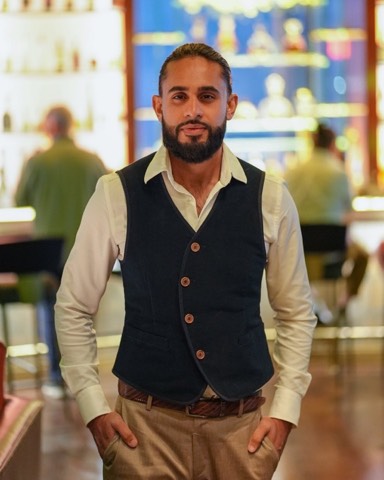
Why Photography Plus Coaching Beats Photography Alone
This is where most guys stop short. They finally decide to invest in better photos — smart move — and hire whichever local photographer has decent reviews and a nice portfolio. They get technically excellent images back. And their match rate barely moves, because gorgeous photos of the wrong angles, the wrong outfits, the wrong energy, or the wrong photo order still don't solve the actual problem.
A generic photographer can make you look good. That's their job, and a skilled one will do it well. But they generally don't know what triggers a swipe, what kills momentum in a bio, what photo sequencing actually converts, or how the psychology of split-second judgment works on a dating app specifically. They're shooting for a portfolio, not for a match rate.
That's the entire premise behind Vegas Tinder Photography. Mike isn't just a photographer with 15-plus years behind the camera — he's also been a dating coach for over 14 years, which means every session is built around one outcome: more matches, better conversations, and higher-quality connections, not just nicer pictures. The photography and the strategy aren't separate services bolted together. They're the same process, because a photo that "looks nice" and a photo that "gets swiped right" are not automatically the same photo, and understanding the difference is the entire value of working with someone who's spent over a decade studying both sides of this.
That combination — professional-grade images plus an actual working knowledge of dating app psychology and behavior — is what moves someone out of the flat, invisible part of the curve and into the part where the math starts working in their favor. It's engineering, not luck. Camera angle, lighting setup, wardrobe choices, photo order, even which environments read as "interesting" versus "trying too hard" — every one of those decisions gets made with the swipe in mind, not just the shot.
What "Engineered for the Swipe" Actually Means in Practice
It's a specific process, not a buzzword. It starts before the camera ever comes out — figuring out what story your current photos are accidentally telling, what's missing from the lineup, and what locations and outfits actually match your real personality instead of some generic "dating app guy" template that ends up looking like everyone else's profile. Las Vegas is genuinely useful here — the city offers backdrops most cities can't: neon-lit streets, desert landscapes twenty minutes from the Strip, rooftop skylines, and a level of visual variety that makes a six-photo lineup look like a full, interesting life instead of one outfit shot six different ways in the same location.
From there it's about directing real, natural-looking moments instead of stiff, posed ones — the kind of photo that looks like it was pulled from an interesting week of someone's actual life, not a studio session, even though every element of it was planned. Genuine expression reads as confidence. Confidence is one of the single strongest visual signals in the entire swipe decision, and it's very hard to fake convincingly in a bad photo, which is exactly why so many average profiles feel flat even when the person themselves isn't.
Then it's photo selection and sequencing — not just picking the best individual shots, but ordering them so the profile tells a coherent, escalating story: strong first impression, proof of range and lifestyle, a glimpse of personality, something that gives a future match an easy, obvious thing to comment on. That last part matters more than people think. A great opener photo gets the swipe. A well-sequenced profile gets the message.

The Real Cost of Staying Average
It's worth being blunt about what "average" actually costs, because most guys never do this math. Every week spent with underperforming photos is a week of matches that never happened, conversations that never started, and dates that never got booked — not because of anything about the guy himself, but because of a handful of fixable, technical problems with how he's being presented on a screen for half a second at a time.
Stack that up over months, sometimes years, and it's a genuinely significant amount of dating life spent invisible for reasons that had nothing to do with actual compatibility, attraction, or chemistry — and everything to do with lighting, angles, and a photo lineup that never got a real strategic look. That's the actual cost of "I'll just use what's on my phone." It's not that those photos are terrible. It's that terrible and average get treated almost identically by an algorithm and a swiping audience that's only rewarding the top of the curve.
Compare that to the cost of a professional session. It's a single afternoon, a fixed cost, and a set of images that keep working for months — across Tinder, Bumble, Hinge, and anywhere else a first impression matters, including LinkedIn if we're honest about it. Framed that way, professional dating app photography isn't an indulgence. It's closer to fixing the one input in the entire process that was quietly working against you the whole time.
What This Looks Like Once the Math Flips in Your Favor
The guys who go through this process and actually change their results almost always describe the same shift: it's not that they suddenly became a different, more attractive person. It's that the apps started treating them like someone worth paying attention to, and that changed everything downstream — more matches, sure, but more importantly, higher-quality matches, better opening conversations, and dates that felt like they were starting from a stronger position instead of an uphill one.
That's the real value of moving out of the "average and invisible" zone and into the top tier of the distribution. It's not vanity. It's not about becoming someone else. It's about making sure the very first, split-second impression you make actually reflects the person you already are, instead of working against you because of bad lighting or a five-year-old photo or an outfit that doesn't do you any favors. Once that first impression is solid, everything else — your personality, your humor, your actual dating skills — finally gets a chance to do its job.
Photos Get You the Swipe. Strategy Gets You the Date.
It's worth saying clearly: great photos alone aren't the entire answer, and anyone who tells you otherwise is only solving half the problem. Photos win the first-impression decision. What happens after that — the bio, the opening messages, how you carry a conversation, how you set up the actual date — still matters enormously, and it's exactly why photography and coaching work better together than either one does alone. A killer profile that leads to conversations that go nowhere is still a wasted opportunity. This is the whole reason the coaching side of Vegas Tinder Photography exists alongside the camera — because getting the swipe is only step one.
Ready to Stop Being Invisible?
None of this is about becoming someone you're not. It's about closing the gap between what you actually bring to the table and what a stranger scrolling through a feed of hundreds of profiles gets to see in half a second. Right now, for most guys, that gap is enormous — and it's almost entirely fixable.
The apps aren't going to start dividing attention more fairly. That's not how the system works, and it's not going to change because it's frustrating. The only real move is to stop competing in the flat, crowded, invisible middle of the curve and start showing up the way the top tier already does — sharp, current, strategic, and unmistakably worth a second look.
That's exactly what a session with Vegas Tinder Photography is built to do: professional dating app photography paired with real, experienced dating coaching, aimed at one outcome — better matches, better conversations, and dates that actually happen. If you're not sure where your current profile is falling short, a free strategy call is an easy, no-pressure way to find out before you commit to anything. Sometimes the fix is smaller than you think. Sometimes it's exactly the gap that's been quietly costing you matches for months. Either way, it's worth finding out — because staying average on purpose, once you know what it's actually costing you, doesn't make a lot of sense.
Want photos that actually get results?
Book a free strategy call — we'll map out exactly what your profile needs.
SCHEDULE FREE CONSULTATION